 ibkr canary
Architecture
ibkr runs on your machine and connects to one Interactive Brokers TWS or IB
Gateway session. It adapts that session for humans, AI hosts, and the Canary
app, and it adds a risk harness. One ownership rule shapes the design:
The daemon owns all broker-connected and runtime-state capability: the connection, observed state, schedulers, durable authority, and policy execution. Every other process adapts typed contracts for its audience, and none of them owns broker state.
A few local workflows are deliberate exceptions: watchlist edits, setup, updates, process management, and offline research or backtests all run without daemon RPC.
System overview
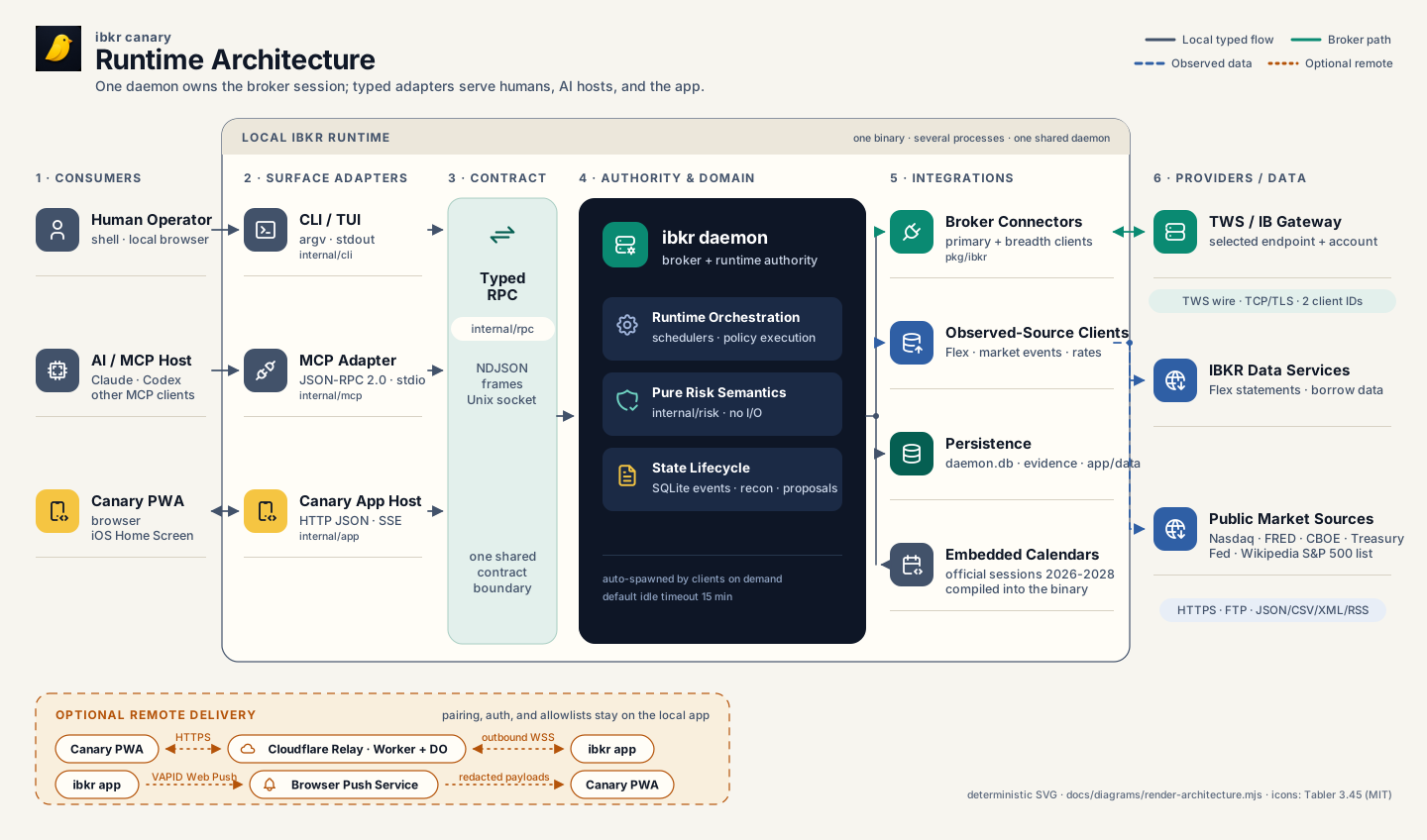
PNG fallback · SVG source generator · Tabler Icons license
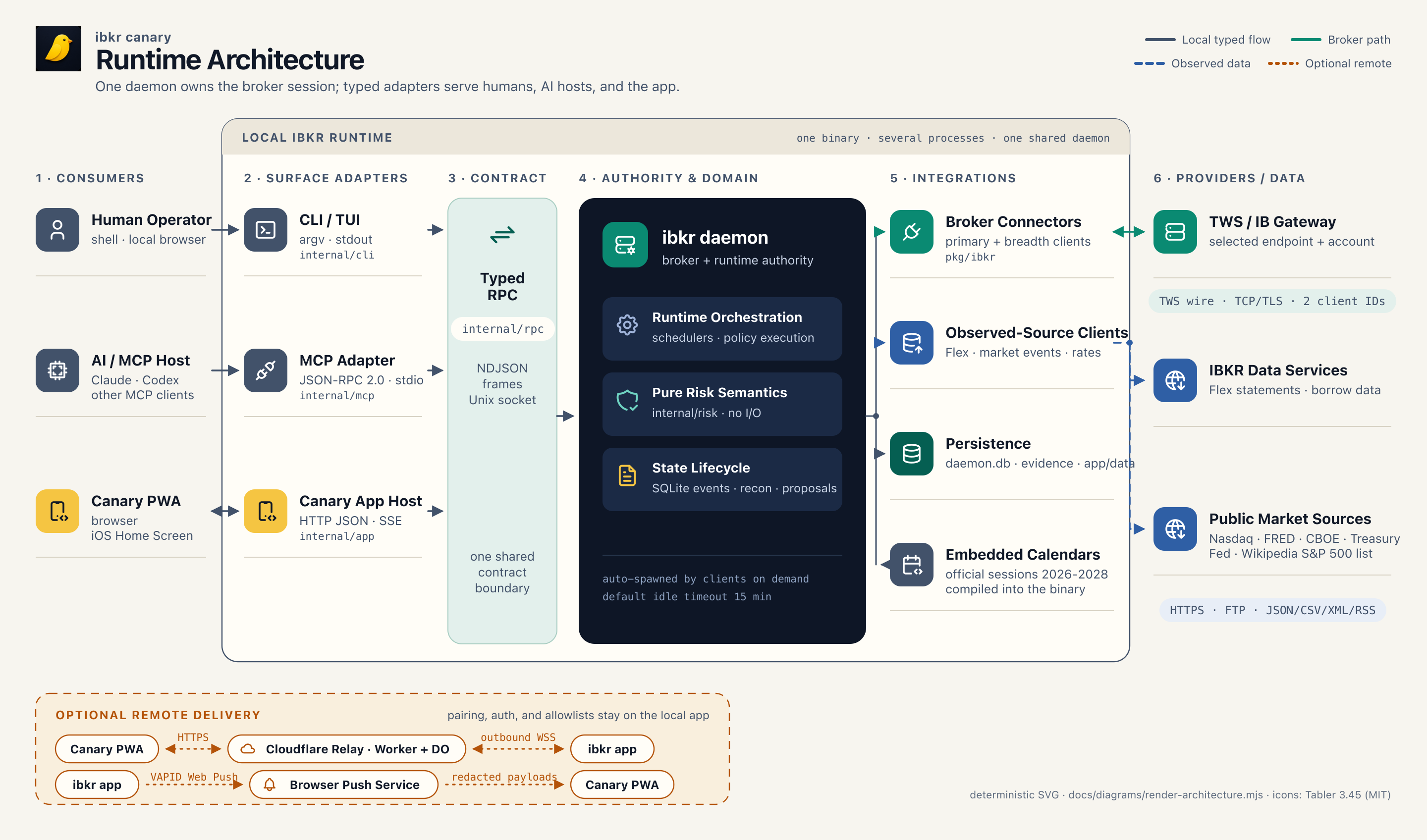
The numbered columns are six layers of one system: consumers, surface adapters, the shared typed contract, daemon authority and domain logic, integration clients, and external providers or data.
All local modes ship in the same ibkr binary. They differ in lifetime and
authority.
| Process or surface | Lifetime | Responsibility |
|---|---|---|
| CLI / TUI | One command | Validates input, calls the daemon for broker and runtime work, and renders human or JSON output. A few local-only workflows run without the daemon. |
ibkr daemon |
Demand-driven background process or foreground service | Owns the broker connections and all runtime state: daemon.db, refreshable in-memory views, schedulers, source ingestion, risk-policy execution, proposals, opportunities, and reconciliation. |
ibkr mcp |
Long-lived child of each MCP host | Speaks MCP JSON-RPC 2.0 over stdio and translates tools and resources into short daemon calls. The surface serves read, research, and preview work; it exposes no broker-write tools. |
ibkr app |
Independently run or supervised HTTP process | Serves the embedded Canary PWA and owns pairing, auth, and app state. Maintains the live snapshot and quote streams, emits SSE, and can connect to the remote relay and Web Push. |
| Canary Paired PWA | Browser or iOS Home Screen app | Renders authenticated snapshots, receives SSE and push notifications, and keeps device-side credentials and recovery state. It is a plain PWA, not an Android Trusted Web Activity. |
| TWS / IB Gateway | Interactive Brokers process outside this repo | Terminates the local TWS API socket and maintains the broker-managed session. |
The default topology is one daemon shared by the CLI, every local MCP adapter process, and the app, over the canonical Unix socket. A flock-backed lock enforces one daemon per socket directory. Inside the daemon, a primary broker connection serves interactive, account, and gamma work, while a second client connection carries the S&P 500 breadth history fan-out.
Clients auto-spawn the daemon when the socket is absent, and it exits after
15 idle minutes unless foreground mode disables the timeout. daemon.db and
the separately listed configuration, evidence, and app files survive;
refreshable in-memory views do not.
Code ownership layers
pkg/ibkris the clean-room TWS wire client: protocol framing, sockets and TLS, request IDs, broker callbacks, contract resolution, and order-wire details.internal/daemonis the long-running authority. It owns both broker connectors, the external-source clients, refreshable views, schedulers,daemon.db, risk-capital runtime state, daily Flex ingestion, and post-trade reconciliation.internal/riskis the pure evaluation library behind advisory verdicts: thresholds and fingerprints, canary signal types, option math, the daily trading rulebook, and risk-constitution evaluation. It does no I/O and owns no broker state.internal/rpcdefines the typed method names and request/response structs that daemon, CLI, app, and MCP adapters share. Add fields here first; teach surfaces to render them second.internal/cliadapts commands to daemon methods or to a local-only workflow. Broker policy and state do not belong in the renderer.internal/mcpadapts MCP tools and resources to daemon contracts. Tool descriptions are product surface and must match the real authority and data quality.internal/appowns the HTTP host, device auth, app-local persistence, live polling and streaming, SSE fanout, Web Push, and the optional outbound relay. The live cache is the normal read path; settings, reviews, and order, proposal, or opportunity actions make direct typed daemon calls instead.cloudflare/remote-relayis a Worker plus a Durable Object used as transport. It forwards framed HTTP and SSE traffic over the app's outbound connector, and owns no device grants, pairing sessions, browser sessions, daemon access, or broker credentials.web/appis the embedded no-build Canary SPA and its service worker. Global account, market, and sync state stays outside individual tab content.
The desk-facing Trading Policy reference explains who decides each control, what is advisory today, how runtime-local version checks behave, and which broker-write gates no policy may weaken.
Data flows and protocols
The daemon protocol and the MCP protocol are different on purpose; only the MCP side is JSON-RPC 2.0.
| Flow | Protocol and payload | Notes |
|---|---|---|
| Human → CLI | argv / stdin; human text or JSON on stdout |
One-shot local process. |
AI host → ibkr mcp |
MCP JSON-RPC 2.0, newline-delimited over stdio | The host owns the process lifetime. |
| CLI / MCP / app → daemon | Custom typed newline-delimited JSON request/response frames over a Unix domain socket | The envelope uses project fields such as ok, frame, stream, and end. It is not JSON-RPC 2.0. |
| App live service → daemon | Periodic typed calls plus long-lived quote streams | Feeds one app snapshot/cache and its change fanout. The source-neutral alert snapshot is ingested directly into the app's private inbox store and is excluded from the public live/SSE DTO. |
| App request routes → daemon | Request-driven typed calls over the same Unix socket | Used where a route needs a fresh action, review, or settings response instead of the cached snapshot. |
| Daemon → TWS / Gateway | Clean-room TWS wire protocol over TCP, optionally TLS | A primary interactive connection, plus a breadth connection with its own client ID and rate budget. |
| Browser / PWA ↔ app | Public static assets and pairing/auth endpoints, then authenticated HTTP(S) JSON and /api/events Server-Sent Events |
Local and LAN access reaches the app directly. Pairing-session creation is loopback-only. |
| PWA ↔ remote relay | Public HTTPS carrying allowed HTTP/SSE traffic | Optional remote path. |
| App ↔ remote relay | HTTPS registration, then authenticated outbound WSS | Requests and streaming responses travel as frames over the WebSocket. The local connector enforces the forwarded-path allowlist. |
| App → browser push service → PWA | VAPID-authenticated Web Push over HTTPS | Push payloads are redacted, and the relay is not in the delivery path. |
| Daemon → external observed-data sources | Scheduled or on-demand HTTPS/FTP; JSON, CSV, XML, RSS, and text | Source health and stale or unknown states stay explicit in typed results. |
Broker and external data sources
Market context arrives from the broker session and from independent public sources.
| Source | Runtime path | Data |
|---|---|---|
| TWS / IB Gateway API socket | TWS wire protocol over TCP/TLS | Account, positions, quotes, option chains/Greeks/OI, historical bars, scanners, order lifecycle, shortable-share observations, subscription-gated Wall Street Horizon earnings events, and broker WhatIf/eligibility. This includes an exact-contract historical FEE_RATE context fallback for currently held short stocks when the due FTP source is unusable; its scale is uncommissioned and policy-ineligible. |
| IBKR Flex Web Service | HTTPS POST and polling | Daily raw Flex XML statements used as broker statement truth for reconciliation. |
| IBKR short-stock availability | FTP | Primary global borrow availability and annualized fee-rate evidence; only current/session-valid rows can drive the extreme-fee flag. |
| Nasdaq | HTTPS JSON, pipe-delimited text, and RSS/XML | One independent earnings-date input, Reg SHO threshold securities, and LULD/trade-halt context. |
| FRED, CBOE, Federal Reserve, US Treasury | HTTPS CSV/XML | Public regime and rates series. |
| Wikipedia S&P 500 list | Scheduled HTTPS refresh | Breadth constituent membership, with a validated SQLite projection and embedded fallback. |
| Official exchange calendars | Embedded Go data | Handwritten build-time tables for US equities, US options, and Xetra, covering 2026 through 2028; a date outside coverage reports an explicit unknown state. There is no runtime calendar network call. |
Market-event flags are daemon-owned observed context. Adapters render or filter
the typed market_events.snapshot; they do not refetch Reg SHO, halt,
borrow-inventory, borrow-fee, or earnings sources, and they do not duplicate
proposal-blocking policy or recreate risk and trading verdicts.
Market-event, earnings-provider, contract-resolution, and membership projections
plus retained observations live in daemon.db. Earnings and FTP borrow-fee
attempts retain typed failure and retry state there, so a restart cannot erase a
failed source read. Other refreshable views stay in memory or use disposable
scratch only.
The primary FTP borrow-fee state and the exact-contract TWS fallback use
separate documents, so a portfolio-only result can never replace the global
last-good. The daemon owns the borrow_fee_coverage projection: FTP is global
authority, while historical FEE_RATE is bounded by the atomic portfolio
rows/receipt, exact ConID and route, and a same-scope check before persistence.
TWS keys combine an opaque account-scope fingerprint with the complete exact
contract identity; observations remain decision-ineligible while the scale is
uncommissioned. Persisted fallback attempts are dated context and never suppress
a fresh post-restart entitlement/data read. Restart discards runtime
entitlement, failure, and backoff state; only an exact identical-wire 15-second
retry boundary survives, so a bounce cannot duplicate the same broker request
immediately.
Reviewed terminal/non-reporting earnings evidence is also daemon-owned typed
state. An optional private [rulebook].terminal_evidence_file is read only at
startup as a validated import/update; rule snapshots serve the committed
exact-contract SQLite revision and never fall back to the file or ticker text.
Explicit removal retains a per-ConID revocation watermark in that SQLite
document, and reactivation requires record verification strictly later than the
watermark, so bumping only the import wrapper cannot resurrect old evidence.
Every initialize/import/update/revoke revision atomically appends a typed,
prose-free authority-change observation with the old/new catalog fingerprints,
review times, and per-contract dispositions. Rule-transition event payloads link
an accepted terminal classification back to that chain with the exact contract
ConID, authority revision and record fingerprint, review and validity times, and
classification, or else an explicit empty linkage list. Either way they exclude
issuer/symbol text, CIK, source URLs, and evidence prose.
Data and persistence
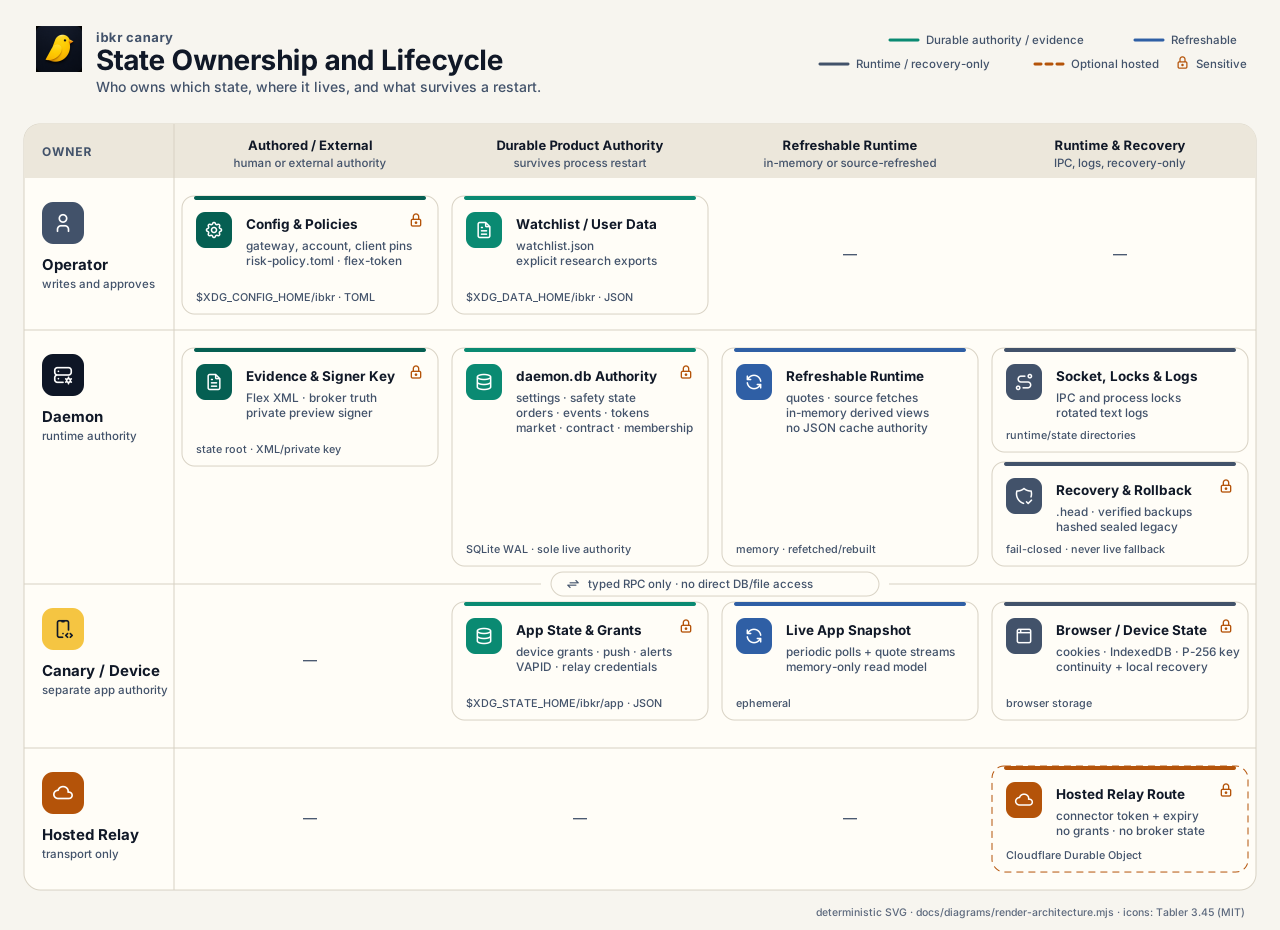
PNG fallback · SVG source generator · Tabler Icons license
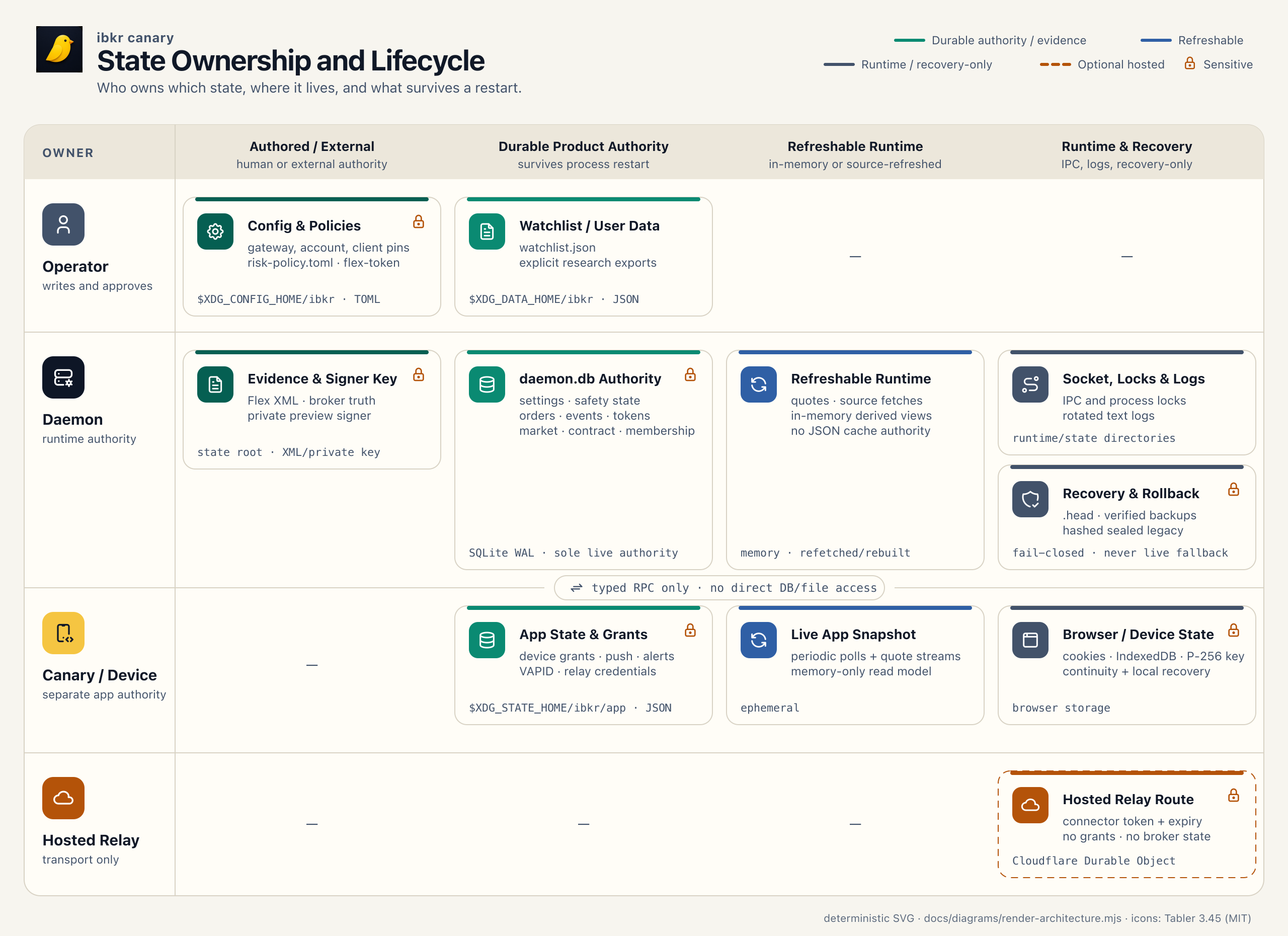
Configuration is operator-owned, and daemon state and app state are separate
authorities. daemon.db is the daemon's sole live authority for mutable state,
append-only events, orders, and retained market observations. Retained Flex XML
remains original broker evidence; the daemon transactionally refreshes its
typed statement inventory and equity projection in daemon.db from the
complete XML set. See Storage for why the daemon uses SQLite,
the physical data relationships, truth boundaries, supported query paths,
durability and upgrade mechanics, and current recovery limits.
| Class | Default location | Owner and representative contents |
|---|---|---|
| Operator configuration | $XDG_CONFIG_HOME/ibkr/config.toml, falling back to ~/.config/ibkr/config.toml; policy defaults under ~/.config/ibkr/policies/ |
Gateway/account/client pins, daemon/trading settings, protection/opportunity policy, the operator-authored risk-policy.toml, the optional private terminal-evidence import path, and the separate flex-token secret. The risk policy has no embedded default: missing approval stays unapproved. |
| Daemon durable authority | $XDG_STATE_HOME/ibkr/daemon.db (SQLite, WAL), falling back to ~/.local/state/ibkr/daemon.db |
Sole live daemon authority for platform settings, risk-capital and governance state, the last-good Regime publication and projection receipt, source-neutral alert episodes, trading readiness, purge state, orders and token tombstones, proposals and opportunities, decision/event history, retained observations, and statement projections. It is not delete-safe and never falls back to legacy files. |
| Original broker evidence | $XDG_STATE_HOME/ibkr/statements/flex-*.xml |
Immutable retained Flex statements. SQLite stores a complete current inventory, immutable file/equity versions, and current per-day winners derived transactionally from this set; it does not replace the XML evidence claim. |
| Recovery artifacts | $XDG_STATE_HOME/ibkr/backups/, $XDG_STATE_HOME/ibkr/legacy-sealed/<cutover-id>/, and $XDG_STATE_HOME/ibkr/daemon.db.head |
Verified database backups, hashed pre-cutover artifacts, and the external monotonic-head watermark. They are recovery and anti-rollback material only, never normal read fallbacks or dual-write targets. |
| Private signer key | $XDG_STATE_HOME/ibkr/order-preview-key-v2 |
Private token-signing material bound to the current authority generation. It is deliberately outside ordinary database state. |
| App durable state | $XDG_STATE_HOME/ibkr/app, falling back to ~/.local/state/ibkr/app |
Private state.json with device grants, push subscriptions, VAPID material, the source-neutral alert inbox, unread cursor, delivery attempts and receipts, delivery health, and relay credentials; app.lock enforces one app process per state directory. |
| Disposable scratch | $XDG_CACHE_HOME/ibkr, falling back to ~/.cache/ibkr |
Updater and transport scratch only; it is never daemon business-state authority. Contract, membership, regime, breadth, gamma, and decision data are SQLite projections/observations or refreshable in-memory views, not live files here. |
| User data | $XDG_DATA_HOME/ibkr, falling back to ~/.local/share/ibkr |
watchlist.json; explicit research exports are separate operator-created files. |
| Runtime IPC and logs | $XDG_RUNTIME_DIR/ibkr/ibkr.sock, falling back to ~/.cache/ibkr/ibkr.sock; daemon log defaults to ~/.local/state/ibkr/ibkr-daemon.log |
Unix socket, sibling lock/PID file, rotated daemon text log, and optional macOS LaunchAgent/app logs under ~/Library. |
| Browser / PWA state | Browser cookie jar, IndexedDB, and localStorage |
Short-lived session, durable HttpOnly device continuity, P-256 device key, local recovery material, preferences, and a non-authorizing relay route identifier. |
| Hosted relay state | Cloudflare Durable Object | Connector token and expiry for the optional route. It stores no device grants or broker state. |
History and imported observations
The four history commands (ibkr regime history, ibkr rules history,
ibkr canary history, and ibkr recon equity) query daemon.db through typed
daemon RPC; MCP and the app currently expose no history surface. Order reads use
the same database authority. There is no history.db ingest path, journal scan
fallback, rotation job, or dual write after cutover, and the legacy decision
histories deliberately start empty.
Imported historic market and gamma measurements are immutable observations
stamped decision_eligible=false in a typed, non-null column with provenance
metadata. They support research but never seed current state or a current
verdict. One narrow cutover repair exists: when gamma has no current last-good
document, the daemon may strictly validate the newest quarantined legacy gamma
observation and promote a copy to the gamma state slot with
authority_provenance=recovered_legacy_observation. The immutable observation
remains byte-exact and decision-ineligible, and the promoted copy is
context-only until a fresh current-code compute replaces it. Current state
always wins; this is not a generic history fallback or a revival of file
authority.
Cutover preserves safety-critical settings, capital/governance continuity, active or uncertain order chains, consumed-token tombstones, conservative order-ID floors, and purge rows and fill cursors. Trading readiness resets; current regime state and regime/rules/canary/proposal/opportunity decision history start clean, as do brief comparison baselines and proposal/opportunity snapshots.
Durability boundaries
Startup validation finishes before state adapters attach, the RPC socket is
served, or either broker connection starts. A database that fails it, or that
carries no daemon.db.head watermark, fails closed and waits for explicit
verified recovery. Corruption is never repaired automatically: recovery and
broker/order reconciliation are a separate operational procedure.
Storage has the durability settings, the validation checklist,
the upgrade sequence, and the current recovery limits.
Never persist broker market-data entitlements. Expose observed data type, quality, freshness, and warnings on typed read surfaces instead.
Regime and alert authority
The current Regime result is one immutable, daemon-owned last-good document with
typed authority health for fresh, stale, refreshing, and cold unavailable state.
Streak, rule-stage, and decision-event projections bind to the exact publication
revision, commit time, and semantic fingerprint; a separate receipt makes the
single-revision crash window replayable before the RPC socket or a later
publication is allowed. An unreceipted revision is withheld atomically from
Regime consumers. A clock behind the retained commit is explicit clock_invalid
stale context and cannot publish a refresh or relax the rulebook until it
catches up.
Regime source quality is not a weak form of market stress. Missing, broken,
contradictory, or cadence-overdue required evidence produces the explicit
data_quality lifecycle and “Market state undefined — data incomplete.” Only
exact producer-authored not_due schedules remain context. Independently
current confirmed stress may survive an unrelated source defect with degraded
readiness, but every confirming row, source-health record, and direct tape
witness must itself be current.
The daemon's alert registry is source-neutral and durable: it owns opaque account/mode-scoped episode and occurrence identity, producer lifecycle, and typed source coverage. The app keeps the separate private delivery authority of one inbox, unread cursor, per-target attempt and receipt ledger, delivery health projection, and serialized dispatcher for every alert source.
The first complete, current snapshot in each authority scope sets a cutover baseline. Conditions already active at that boundary remain visible but cannot create a backlog push. Later delivery requires a current candidate, current and covered evidence from that exact source, an allowed app notification mode, an active target, and no prior accepted receipt. The dispatcher durably reserves and rechecks each occurrence-and-target attempt before Web Push, maps the daemon's closed presentation code to fixed app-owned copy, and records acceptance, retry, rejection, or uncertain interruption. Scope changes create only bounded generic previous context; they are not recovery, clear, unread, or delivery events. See Alerts and Regime production contract.
Running more than one instance
You can run more daemon, gateway, or account scopes, but nothing multiplexes
them for you. An isolated stack needs its own config, socket, and log, its own
gateway, account, and client pins, and its own XDG state, cache, and data
roots. Most durable paths are XDG-global rather than derived from the socket,
so changing only IBKR_SOCKET does not isolate persistence.
HTTP app and remote access
The app is the only HTTP process. It serves through HyperServe
(github.com/osauer/hyperserve), the project's companion net/http-shaped
server, with method-aware routes, hardened defaults, and SSE formatting. The
daemon listens on the Unix socket and MCP speaks stdio; neither serves HTTP.
Routes register in internal/app/http/routes.go in four families: static
PWA assets, pairing and auth, the authenticated app API, and the
/api/events SSE stream. Handlers read app stores, the live snapshot, or
typed daemon calls; they do not invent policy. There is no separate health
route; /api/bootstrap and /api/snapshot carry relay and liveness state.
Remote access keeps pairing, auth, session validation, forwarding allowlists, and daemon access on the local machine. The Worker and the Durable Object carry route transport state only.
Observability
The observability layer is thin on purpose: text logs, one health surface, typed database evidence, and bounded alert lifecycle and delivery counters. There is no external metrics stack and no tracing.
- The daemon writes structured text logs through
log/slog. Thelog_levelconfig key sets the level; the default isinfo. The log lives at~/.local/state/ibkr/ibkr-daemon.logand rotates at boot once it passes 64 MiB, keeping one older generation. The app logs toibkr-app.log. ibkr statusrenders the daemon'sstatus.healthreport: gateway, session, and TLS state, uptime, background tasks, subsystem health, data quality, data-farm notices, and trading state. It ends in one verdict: ready, attention, offline, or starting.- Typed read surfaces carry their own source health. Regime clusters, gamma, the market calendar, and governance report stale, partial, degraded, or unknown instead of guessing.
- Append-only SQLite events are the evidence trail for orders, regime, rule,
and canary decisions, proposal outcomes, capital events, and risk-policy
governance. Mutable documents use compare-and-swap revisions, while coupled
state/event changes share one transaction.
ibkr briefand the CLI history commands compose or query this typed daemon authority directly.
Reference map
- Sensors: measurement, freshness, last-good, and dependency semantics.
- Trading Rulebook: the compiled discipline model and its evidence contract.
- Trading Policy: the human decision and system-control model.
- Storage: state, evidence, SQLite relationships, query boundaries, durability, and recovery.